


How to Tell Whether Your Reptile Is Happy


A reptile’s calm face doesn’t tell you the whole story. If you’re wondering, “Is my reptile happy?” look at its behavior and living conditions instead. Reptiles have few facial muscles, so a human-style smile isn’t a reliable sign of how they feel.
It’s natural to look for familiar signs of comfort in a pet, but a gecko’s habits can be more revealing than its expression. Hiding isn’t automatically a problem, while frequent attempts to escape or signs of fear deserve a closer look.
Learn how to read your gecko’s behavior, recognize possible stress, and use hiding spaces and humidity monitoring to assess its well-being. The practical steps ahead focus on behavioral patterns and habitat conditions, helping you build a clearer picture of how your reptile is doing.
Key Takeaways
- Look for consistent changes in your gecko’s behavior and routine rather than judging its well-being from a single moment.
- Provide hiding spaces so your reptile can retreat, and consider the full habitat when assessing signs of stress.
- Read reptile behavior on its own terms; human expressions such as smiling aren’t reliable indicators of emotion.
- Notice behaviors that may signal comfort, and distinguish them from fear responses such as trying to escape or withdrawing.
- Monitor humidity against your reptile’s species-specific needs, and treat changes in skin appearance as a reason to review habitat conditions.
Hiding spaces and stress reduction
Pet reptiles need species-appropriate temperatures, lighting, humidity, water, and places to retreat. Match each condition to your reptile’s species, then observe whether its enclosure supports normal movement and access to shelter.
-
Provide Hiding Spaces
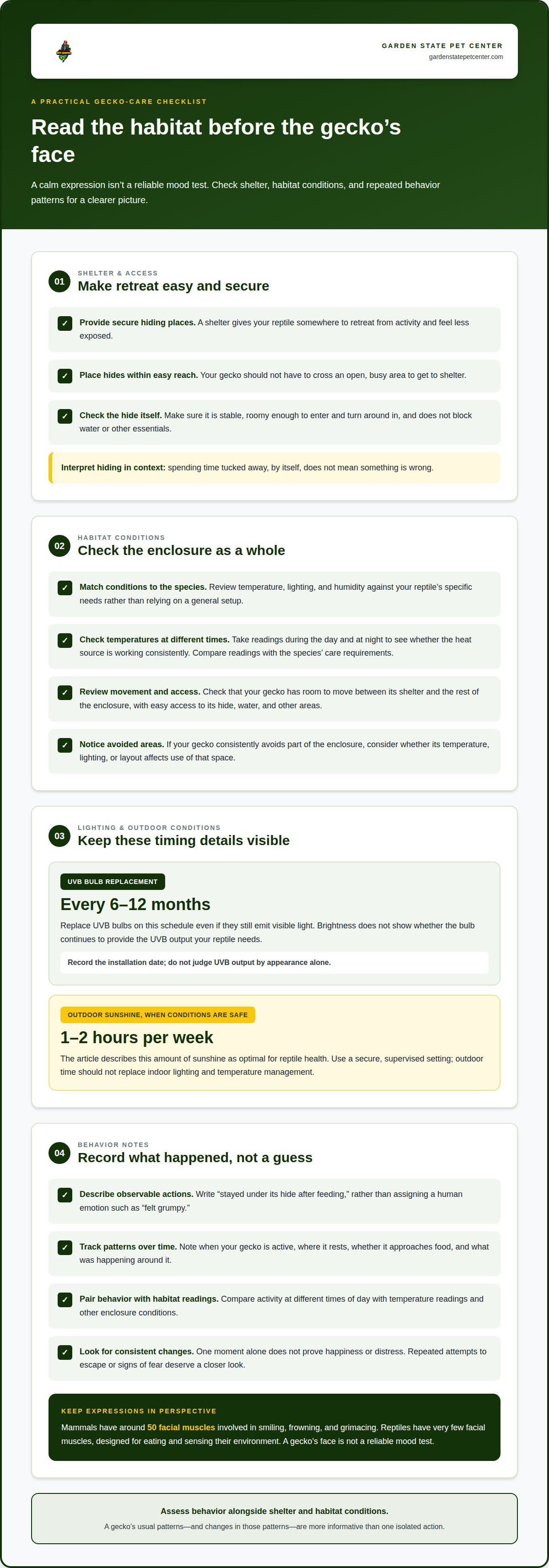
Add secure hiding places so your reptile can retreat from activity and feel less exposed. Position shelters so your pet can reach them without crossing an open, busy area. Check that each hide is stable, roomy enough to enter and turn around in, and doesn’t block access to water or other essentials. If your gecko spends time tucked away, don’t assume that behavior alone means something is wrong.
-
Assess Habitat Conditions
Match the enclosure’s temperature, lighting, and humidity to your reptile’s species instead of relying on a general setup. Monitor a gecko’s temperatures during the day and at night to confirm its heat source works consistently. Review the enclosure’s layout, too: your pet needs room to move between its shelter and the rest of its habitat. Explore reptile terrariums when considering an enclosure suited to reptile keeping.
- Keep the heat source under observation. Check readings during the day and at night rather than relying on a single measurement. Differences between checks can reveal that the heat source isn’t maintaining the enclosure as expected. Record readings alongside your gecko’s activity, then compare them with the species’ care requirements to see whether the habitat needs adjustment.
- Maintain appropriate UVB lighting. Replace UVB bulbs every 6-12 months, even when they still emit visible light. Visible brightness doesn’t show whether the bulb continues to provide the UVB output your reptile needs. Note the installation date so replacement doesn’t depend on judging the bulb by appearance. Keep the setup appropriate for the species rather than selecting a bulb by brightness alone.
- Consider outdoor sunshine carefully. When outdoor conditions are safe, 1 to 2 hours of sunshine a week is described as optimal for reptile health. Treat this as a habitat consideration, not a reason to take a reptile outside in unsuitable conditions. A secure, supervised setting matters, and outdoor time shouldn’t replace the lighting and temperature management your pet needs indoors.
- Observe how your reptile uses its enclosure. Notice whether it can reach its hide, water, and other areas easily. Compare behavior at different times of day with habitat readings, since one isolated action doesn’t explain the full picture. If your gecko consistently avoids part of its enclosure, consider whether the temperature, light, or layout affects how comfortably it can use that space.
Anthropomorphism
- Separate observation from interpretation. Write down what your reptile does before deciding what it means. For example, record “the gecko stayed under its hide after feeding” rather than “the gecko felt grumpy.” The first statement describes something observable; the second assigns a human emotion. This distinction helps you compare behavior over time without treating one moment as proof of happiness or distress.
- Don’t use a smile as a mood test. Mammals have around 50 facial muscles involved in smiling, frowning, and grimacing. Reptiles have very few facial muscles, designed for eating and sensing their environment. A gecko’s still expression, open mouth, or lifted head doesn’t translate neatly into a human facial emotion. Assess the animal’s behavior and surroundings instead of reading its face as a direct emotional message.
- Describe actions in species-neutral terms. Note whether your reptile eats, moves around, rests, or retreats, then consider the circumstances. A gecko that stays hidden may simply be using its shelter; that action alone doesn’t show that it feels lonely or unhappy. Likewise, an animal sitting still isn’t necessarily “sulking.” Record the action and context, such as whether it happened after feeding or during a change in the room.
- Check the setting before assigning a motive. If your reptile avoids an area, note which area and the conditions there. A gecko steering clear of a bright or warm spot could be responding to its environment rather than rejecting you. Compare its choices with the enclosure’s lighting, temperature, and layout. This turns assumptions about affection or dislike into useful observations about habitat and routine.
- Use repeated observations, not a human story. Track the same behaviors over time: when your gecko becomes active, where it rests, and whether it approaches food. One refusal to emerge doesn’t establish sadness, just as one active period doesn’t prove excitement. Look for changes in the animal’s usual pattern and connect them to observable events. Keep notes factual so comparisons don’t depend on interpreting a reptile’s face.
- Choose descriptions that guide care. Replace “she’s being stubborn” with “she stayed in the hide while I changed the water.” That wording identifies an event you can review without claiming to know the gecko’s thoughts. Use the same method to describe feeding, movement, and retreat. Concrete records help you assess behavior alongside habitat conditions and notice changes without expecting reptile communication to match human expressions.
Behaviors that may indicate a gecko is happy
Behavior and body language differ by species, so assess a gecko against its own usual patterns, not a snake’s or turtle’s. Look for several consistent signs of normal activity and comfort instead of treating one action as proof of happiness.
- Observe your gecko during its usual active periods. Note whether it explores, moves between areas, or responds to familiar routines. A gecko that appears at its usual times and moves around its enclosure gives you useful behavior to track. Don’t expect constant activity; compare what you see with your pet’s own routine, including when it rests or stays out of sight.
- Track feeding behavior across multiple meals. Record whether your gecko approaches and eats its usual food instead of drawing conclusions from one feeding. For example, note whether it eats normally after a routine enclosure check, then compare that with later meals. A repeated change in appetite is more informative than one missed feeding, especially alongside changes in activity or other noticeable behavior.
- Watch how your gecko moves through its enclosure. Notice whether it can reach different areas and move with its usual coordination. Record actions such as climbing, walking, or pausing to investigate an object. Avoid calling a gecko “playful” based on one movement. Describe the action and compare it with previous observations so you can recognize a real change in its normal movement.
- Notice responses to familiar, low-key activity. Observe whether your gecko stays settled, continues exploring, or retreats when you approach its enclosure. Keep your approach consistent, such as moving slowly from the same side, and record what happens. Retreating doesn’t automatically mean fear, just as staying still doesn’t prove trust. Look for a repeated response in the same situation before interpreting it.
- Include shedding in your observations. Geckos shed frequently while growing, so note visible shedding alongside their usual feeding and movement. Don’t treat shedding alone as a sign of happiness or distress. Record when it occurs and whether your gecko’s behavior changes around that time. This provides context for comparing routine activity instead of interpreting one temporary change in isolation.
- Build a simple behavior record. Use a notebook to note the date, feeding, activity, and any noticeable changes. For example, write “ate, explored, then rested in its hide” rather than “seemed cheerful.” After several entries, compare similar routines and look for repeated patterns. If appetite, movement, or everyday behavior changes noticeably, take the pattern seriously instead of relying on one “happy” sign.
A behavior that’s typical for one reptile may not mean the same thing in another. For a gecko, compare its behavior and body language with its own established routine rather than using a snake’s or turtle’s patterns as a guide.
Fear in reptiles
- Notice immediate escape or defensive responses. A reptile may flee, freeze, hide, or react defensively when startled or approached. Watch what happens when you reach into the enclosure or move nearby. For example, if your gecko repeatedly darts away when a hand enters, pause handling and give it space. Record the situation, since one startled response alone doesn’t establish a lasting problem.
- Reduce the trigger instead of forcing interaction. Move slowly, avoid sudden movements near the enclosure, and stop handling if your reptile struggles to escape. Give it time to settle before trying again. A gecko that retreats when someone approaches is communicating through its behavior, not misbehaving. Keep interactions predictable and brief, then observe whether its response changes with a calmer approach.
- Distinguish fear from possible illness. Common signs of illness in pet reptiles include vomiting, appetite loss, or a lumpy stomach, which can indicate impaction in a gecko. Poor diet, lack of calcium, dehydration, and overfeeding can contribute to impaction. Note these changes separately from fear responses, such as fleeing when approached, because health signs call for a different response.
- Match feeding to the species and life stage. Reptiles don’t share a single feeding schedule or universal diet; appropriate foods and frequency depend on the species and its growth stage. A gecko’s food requirements differ from those of a snake or turtle. Follow a species-specific feeding plan, provide suitable food, and record meals and appetite. Don’t automatically offer extra food after a missed meal.
- Arrange veterinary care for concerning health signs. Contact an exotic-animal veterinarian when your reptile vomits, loses its appetite, or develops a lumpy stomach. These signs may indicate gecko impaction, and the listed causes include dehydration and overfeeding. Share when the change began, what the animal has eaten, and any observed behavior. This history gives the veterinarian concrete details to assess.
- Keep a behavior and health log. Write down the date, trigger, your reptile’s response, and any changes in feeding or body condition. For example, note whether a gecko hid after enclosure maintenance or showed appetite loss at mealtime. Compare repeated entries instead of interpreting one event in isolation. A clear record helps distinguish a handling reaction from a pattern that calls for veterinary attention.
Humidity and monitoring
Space, heat, UVB lighting, and humidity needs vary by species; provide room to move and monitor habitat conditions. For humidity, bearded dragons and leopard geckos need 20-30%, while ball pythons and green anoles need 50-60%.
- Measure humidity in the enclosure. Use a hygrometer and compare its reading with your reptile’s species-specific needs. A bearded dragon or leopard gecko has different humidity requirements from a ball python or green anole. Don’t adjust moisture based on guesswork or another species’ setup. Record readings at consistent times so you can notice changes and respond to a pattern.
- Check conditions across the habitat. Place the humidity monitor where it reflects the area your reptile uses, then consider whether conditions differ elsewhere in the enclosure. One reading may not describe every microclimate, especially when the layout includes warmer and cooler areas. Review humidity alongside temperature and your gecko’s behavior to understand whether the enclosure supports its daily needs.
- Compare skin appearance with recorded readings. Gecko skin discoloration or paleness may indicate unsuitable enclosure humidity. Note when the change appears and what the hygrometer reads instead of changing several habitat conditions at once. This helps you see whether appearance and humidity shifts occur together. A written record also helps distinguish a one-time observation from a recurring change.
- Monitor heat during daytime and nighttime. Check the enclosure at both times to see whether the heat source is working properly. Reptiles rely on their surroundings, so a reading from only one point in the day can miss a later change. Log each reading with its time and compare it with your species’ needs. Adjust the setup according to those requirements.
- Provide species-appropriate space and UVB lighting. Make sure the enclosure lets your reptile move between essential areas without obstruction, and select lighting suited to its species. UVB bulbs should be replaced every 6-12 months, even if they still emit visible light. Track the replacement date; brightness alone doesn’t show whether a bulb is still providing appropriate UVB.
- Use species examples as a guide, not a substitute. Red ear sliders have an optimal humidity range of 50-75%, while ball pythons and green anoles need 50-60%. Those differences show why one target cannot suit every reptile. Check your animal’s species before making changes, then monitor the enclosure and record readings to assess whether conditions remain consistent.
Garden State Pet Center: Reptiles and Amphibians
Garden State Pet Center offers reptiles and amphibians, reptile terrariums, premium pet food, and pet toys and accessories. These products can help when you’re choosing a reptile or reviewing whether your enclosure and supplies suit its care needs.
A terrarium should support the species-specific habitat conditions you’ve assessed, while food and accessories should fit your animal’s needs and routine. Use your observations about behavior, humidity, and enclosure setup to guide your choices. They can help you focus on what may need attention instead of choosing supplies based on appearance alone.
If you’re considering a reptile or updating its setup, contact Garden State Pet Center to discuss your needs.
Keep building a clearer picture of your reptile’s well-being
If you’re asking, “Is my reptile happy?” make your next step a steady, species-aware routine. Notice what changes, keep useful observations together, and use them to make thoughtful decisions about your pet’s environment and care. A consistent approach helps you respond to your reptile as an individual instead of expecting it to show comfort in a human way.
For ongoing pet needs, Garden State Pet Center offers Premium Pet Food and Pet Toys and Accessories, as well as Exotic Birds. Keep your reptile’s specific needs at the center of every choice, and seek veterinary care for concerning health changes.
Contact Garden State Pet Center to discuss your pet-related needs and take your next step with confidence.
Frequently Asked Questions
Can Reptiles Smile or Feel Happy Emotions?
Reptiles don’t smile in the human sense, and a still expression can’t tell you exactly what one feels. You can’t reliably read their emotional experience from a face. Instead, learn your pet’s normal behavior and notice meaningful changes in its routine. A gecko’s regular activity and feeding patterns, for example, offer more useful observations than interpreting a relaxed-looking face as a grin.
Do reptiles feel separation anxiety?
Don’t assume a reptile experiences separation anxiety the way a person or dog might. A behavior change while you’re away may have other explanations, including a disrupted routine or a change in the enclosure. Keep care routines consistent and note what changes when you return. If your reptile’s behavior shifts along with appetite or physical changes, focus on those observable details rather than assigning a human emotion.
Do snakes like being loved?
Snakes don’t show affection in the human sense, so handling shouldn’t be treated as proof of love or a bond. A snake may become accustomed to predictable, gentle handling, but individual responses vary. Approach calmly, support its body, and stop if it repeatedly tries to escape or reacts defensively. Respecting a snake’s signals is more useful for safe, low-stress interactions than seeking cuddling.
How to Foster Positive Interactions with Reptiles?
Start by letting your reptile observe you without reaching into its enclosure. Keep your movements calm and predictable, then offer brief handling only if the animal remains settled. For example, let a gecko approach your hand rather than lifting it suddenly from above. Return the animal to its habitat if it persistently tries to get away. Consistent, low-pressure contact helps you learn which interactions your pet tolerates.
Is My Leopard Gecko Happy & Healthy?
Assess your leopard gecko through its usual routine, not one isolated behavior. Notice whether it eats as expected, moves normally, and completes its regular activities. Geckos shed frequently while growing, so consider shedding in context rather than treating it as a mood signal. A change in skin color or paleness is a reason to review humidity readings. Keep observations together to spot changes over time.
Why do bearded dragons love being rubbed?
A bearded dragon’s tolerance of touch doesn’t prove it enjoys being rubbed. It may stay still for reasons other than enjoyment, so watch what it does before and after contact. Move your hand gently, don’t force interaction, and give the dragon room to move away. If it repeatedly retreats or reacts defensively, stop. The animal’s response, not a human interpretation of its expression, should guide handling.
What are signs that a reptile is healthy and comfortable?
If you’re wondering, “Is my reptile happy?” look for a steady pattern that fits its species: familiar feeding, movement, resting, and use of its enclosure. For a gecko, compare current activity with its typical routine, including time spent hidden. Check that its skin appearance and habitat readings remain consistent with its needs. No single behavior proves health or comfort, but a clear change from baseline is useful information to record.
How can you tell if a reptile is stressed or unhappy?
If you ask, “Is my reptile happy?” consider whether behavior repeatedly changes in response to a particular event. For example, note whether a gecko retreats whenever someone approaches its enclosure and whether that response continues afterward. One retreat doesn’t establish ongoing distress. Persistent changes in feeding or physical condition deserve attention as health concerns, not just signs of an unhappy mood. Keep your observations specific and factual.

Article by
Victor Santucci
Victor Santucci Jr. is the owner of Garden State Pet Center and a Certified Clinical Pet Nutritionist specializing in premium pet nutrition, raw and fresh feeding, holistic pet wellness, birds and exotic animals. Through years of hands-on retail and animal-care experience, Victor helps pet parents make informed decisions about nutrition, enrichment and species-appropriate care.
Share this post
- 0 comment
- Tags: gecko care, habitat setup, humidity monitoring, is my reptile happy, reptile behavior, reptile care, reptile happiness, reptile stress