


Helping a Scared Bird: How to Earn Its Trust


What if the first step toward getting your bird onto your hand is keeping your hands still? If you’re wondering what to do when your bird is scared of you, give it space and approach calmly. Build positive associations by pairing your hands with treats or familiar toys. Let your bird set the pace, and pause or step back if its body language shows discomfort.
It can be worrying when a bird backs away, squawks, or tenses as you come near. That reaction doesn’t mean trust can’t grow. Steady, gentle interactions can help your bird feel safer over time. Learn to approach without rushing, gradually reduce the distance at which your bird retreats, and work toward a calm step-up onto your hand. Make each interaction safe and rewarding rather than expecting your bird to accept handling before it’s ready.
Key Takeaways
- Read your bird’s body language and pause before it feels the need to retreat.
- Build positive associations by letting your bird choose when to approach treats, toys, and your hands.
- Reduce flight distance gradually, moving closer only while your bird remains relaxed.
- Make step-up training a gradual goal, not a test of whether your bird trusts you.
- Explore suitable bird toys and food at Garden State Pet Center to support calm, rewarding interactions.
Can I Teach a Fearful Bird to Step Up on My Hand?
Yes, a fearful bird can learn to step up when you build comfort gradually instead of forcing contact. Trust may take weeks or months. Fear alone doesn’t diagnose illness, but sudden, persistent behavior changes or physical signs warrant an avian vet’s assessment.
-
Recognize Fear and Stress Signals
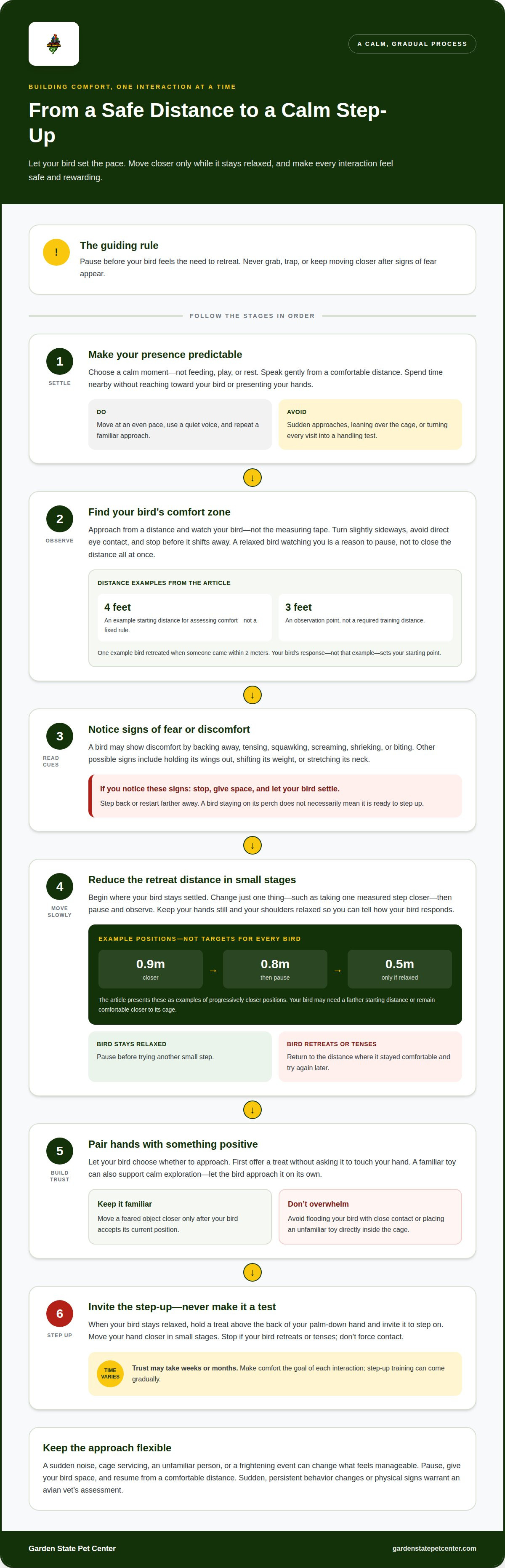
Watch your bird’s posture before moving closer. Backing away, squawking, screaming, biting, or tensing when hands approach can signal fear or discomfort. Holding the wings out, shifting weight, stretching the neck, or shrieking may also indicate fear. Pause when you see these signs. Don’t assume a tense bird is ready to step up just because it stays on its perch.
-
Avoid Forced Handling
Let your bird keep an escape route instead of grabbing it or trapping it in place. Birds are prey animals and generally dislike being grabbed; forced handling can make human hands frightening. Flooding a bird with close contact or a feared object can also overwhelm it. If fear appears as you approach, step back or restart farther away rather than continuing until the bird stops reacting.
-
Consider Causes of Hand Fear
Think about what changed before your bird began avoiding hands. Negative past experiences can create hand fear, and instinctive caution around potential threats may also play a role. A bird that once accepted hands may become wary after a frightening event, including nail trimming. Even a hand-tamed bird may fear handling in a new situation. Past comfort doesn’t mean it welcomes every touch.
-
Build Trust Step by Step
Spend time talking quietly without reaching toward your bird or presenting your hands. To assess its comfort zone, turn slightly away, avoid direct eye contact, and begin approaching from four feet away while watching its body language. During necessary cage tasks, keep your hands hidden in your sleeves if they trigger fear. Let your bird approach a feared object on its own, and move the object closer only after it accepts the current position.
-
Practice the Step-Up Cue
Start by offering a treat without asking your bird to touch your hand. When it stays relaxed, hold the treat above the back of your palm-down hand and invite it to step on. Move your hand closer in small stages, stopping if your bird retreats or tenses. A familiar object can also support calm exploration; the bird collection provides a reference for bird-related items, but avoid placing an unfamiliar toy directly inside the cage.
Approaching the cage slowly and calmly
Help a newly adopted or previously neglected bird feel safer by making your movements predictable and giving it room to retreat. Speak gently from a comfortable distance, approach gradually, and pause before the bird moves away.
- Choose a calm moment to approach, rather than arriving suddenly during feeding, play, or rest. Walk at an even pace toward the cage, then stop before your bird backs away or flies to the far side. One example describes a bird retreating when someone came within two meters. Use your bird’s response, not that example, to find its comfortable starting point.
- Keep your body language nonthreatening as you move closer. Turn slightly sideways, avoid direct eye contact, and don’t lean over the cage as if you’re about to catch the bird. A relaxed posture and quiet voice make your approach easier to predict. If your bird watches without shifting away, pause there rather than closing the remaining distance all at once.
- Use three feet as an observation point, not a required training distance. Notice whether your bird stays relaxed as you approach that distance from its cage. If it stiffens, retreats, or calls out, stop farther away next time. If it remains settled, pause before taking another small step. If you’re wondering what to do when your bird is scared of you, stop before it feels driven to flee.
- Make each approach brief and consistent. For example, walk to the same side of the cage, speak softly, and leave without reaching inside. Repeat this calm pattern during ordinary moments, such as passing by or bringing food. Don’t use every visit to test whether the bird accepts a closer approach; predictable contact helps a new bird learn what to expect.
- Give your bird time to settle after a stressful event. It may need a few more days after a frightening experience, so don’t treat one calm approach as permission to move closer. If it retreats, return to the distance where it stayed comfortable and try again later. For a previously neglected bird, let it observe your routine without requiring contact.
- Adjust your approach when the surroundings change. Cage servicing, a sudden noise, or an unfamiliar person nearby can make a manageable distance feel too close. Pause and give the bird space before resuming. Knowing what to do when your bird is scared of you means respecting that change instead of pressing ahead. For a new arrival, keep early interactions simple: approach, speak quietly, and leave without pursuing it around the cage.
Gradually reducing the bird’s flight distance
- Start at the distance where your bird stays settled, not where you hope it will tolerate you. Stand still and observe whether it remains relaxed or begins moving away. Use that comfortable position as your starting point. The aim is to reduce how far your bird feels it must flee, not to block its escape or make it stay near you.
- Choose one small change in your position, then pause and observe. For example, if your bird stays calm while you stand farther away, take one measured step closer and wait. Keep your shoulders relaxed and your hands still. Don’t add a reaching hand, a new toy, or another challenge during the same approach, so you can tell which change affected your bird.
- Use 0.9m, 0.8m, and 0.5m as examples of progressively closer positions, not as fixed targets for every bird. Your first comfortable distance may be farther away, or your bird may remain relaxed closer to its cage. Move from one position to the next only when your bird stays settled at its current distance.
- Let your bird’s response determine whether you repeat, advance, or retreat. If it stays relaxed at 0.9m, you can try a slightly closer position later. If it leans away, flutters, or moves to the other side, stop advancing and return to a distance where it settles. A retreat is useful information, not a reason to follow the bird around its cage.
- Keep each practice attempt simple and predictable. Approach to the current position, pause, and leave while your bird is still comfortable. On a later approach, repeat that position before trying a closer one. If the bird becomes fearful as you advance toward 0.8m or 0.5m, move back to its last comfortable distance and begin again from there.
- Record the position that worked, using the cage edge or a nearby floor tile as a visual marker. For example, note that your bird remained settled when you stopped beside a particular tile. This gives you a consistent starting point next time and helps prevent accidental leaps from a comfortable distance to a much closer one.
Teaching a hand-wary bird to step up may take weeks, or months when the hand is gradually repositioned. The author recommends extra care once a feared object is within about 10 feet of a bird.
Pairing hands with treats and toys
Make your hand a cue for pleasant choices, not a signal that handling is coming. Use a treat or familiar toy your bird already enjoys, and let it decide whether to approach.
- Begin with your hand outside your bird’s comfortable range. Hold a familiar treat where your bird can see it, then wait without moving closer. If it watches calmly, leave the treat within reach or offer it from a position that doesn’t prompt retreat. If it backs away, move your hand farther away and try again another time.
- Let your bird choose whether to take the treat. Keep your fingers still and avoid following its beak if it hesitates. For example, offer a small piece at the cage entrance, then let the bird lean forward or remain on its perch. The goal is a voluntary approach, not getting the treat into its beak.
- Change only one part of the offer at a time. Once your bird calmly accepts a treat from its current position, try holding it slightly closer to your hand. Keep your posture and voice steady. If your bird stiffens, retreats, or stops approaching, return the treat to its previous position rather than bringing your hand nearer.
- Pair your hand with a toy your bird already knows. Hold the familiar toy nearby without pushing it toward the bird, then let it investigate or play at its own pace. A favorite toy can make your hand’s presence more rewarding. Don’t use a new toy to lure the bird into contact before it feels comfortable.
- Introduce an unfamiliar toy gradually. Place it far enough away for your bird to see it without needing to move away, and let the bird approach on its own. Show that the object is safe by calmly interacting with it nearby. Move it closer only when your bird seems comfortable with its current location; don’t put it against or inside the cage yet.
- Keep treat and toy sessions separate from step-up requests at first. For example, offer a treat, let your bird enjoy it, and withdraw your hand calmly. Once your bird accepts these interactions, you can gradually position a treat above a still hand. Pause if fear returns, and resume at the last position where your bird stayed comfortable.
How do I build trust with a scared bird step by step?
- Start with calm company, not a request for contact. After your bird becomes skittish, spend time nearby talking softly without reaching or showing your hands. For example, sit beside the cage and speak while reading, then leave without asking the bird to move. This lets the bird observe you without each visit becoming an attempt to handle it.
- Keep your approach consistent and nonthreatening. Turn slightly away and avoid direct eye contact as you settle near the cage. During necessary cage servicing, hide your hands in your sleeves if visible hands worry your bird. Complete the task smoothly, then step away. Predictable actions make it easier for the bird to learn what follows your presence.
- Let your bird investigate new or worrying objects at its own pace. Place a feared object where the bird can see it from a comfortable distance, and don’t carry the bird toward it to test its reaction. Show that the object is safe by calmly interacting with it nearby. Wait until your bird is comfortable with that location before moving it closer.
- Use your bird’s response to guide each change. If it becomes uncomfortable when an object moves closer, return it to its original position and begin again. Don’t put the object against or inside the cage until the bird accepts its presence nearby. The time needed varies between birds, so follow relaxed behavior rather than a calendar.
- Wait for your bird to approach willingly before offering petting. A bird that stays nearby isn’t necessarily inviting a touch, so pause and watch its response. When it appears comfortable with petting, offer a brief touch to the front of its neck or its side. Avoid reaching behind the bird, which can turn a calm interaction into a surprise.
- Keep trust-building sessions easy to end. If your bird retreats, becomes tense, or avoids the next interaction, stop and return to an earlier, comfortable step. For instance, spend the next visit talking nearby without reaching. Let the bird choose whether to approach again; repeated, voluntary contact supports progress toward relaxed handling.
- Choose patience over a deadline. A frightened bird may need weeks or months to accept hands, and comfort with a feared object has no fixed timeline. Keep changes small, notice what helps, and adjust when your bird shows unease. For bird-care essentials that can support rewarding interactions, explore bird-care options.
Garden State Pet Center: Exotic Birds
Garden State Pet Center offers Exotic Birds, Premium Pet Food, and Pet Toys and Accessories for bird owners building a comfortable care routine. Choose a familiar treat or suitable toy to support calm, positive interactions, and introduce new items gradually so your bird can explore at its own pace. If you’re preparing for a bird or adjusting your setup, these bird-focused offerings can help you consider the essentials alongside trust-building practice. Small Animals are also part of the store’s selection for households caring for more than one kind of companion.
For guidance on choosing bird essentials, contact Garden State Pet Center.
Make the Next Interaction a Small Win
Trust grows through the choices your bird can make, not through a perfect training session. Pick one manageable goal for your next interaction, such as staying nearby while your bird remains relaxed. If you’re deciding what to do when your bird is scared of you, let its comfort guide the pace and treat a calm pause as meaningful progress. Don’t measure success only by whether your bird steps onto your hand. A bird that chooses to stay, watch, or approach is already engaging on its own terms.
Garden State Pet Center offers Exotic Birds, Premium Pet Food, and Pet Toys and Accessories to support bird care and positive interactions. For help taking the next step, contact Garden State Pet Center. Keep showing up calmly, and give trust room to grow.
Frequently Asked Questions
Is Your Pet Bird Afraid of Hands?
Yes, a pet bird can be wary of hands even if it willingly stays near you. It may react to fingers moving toward its face, hands appearing above its head, or a hand entering its enclosure. Notice which motion triggers the reaction. For example, if your bird accepts food from a still hand but retreats when your fingers move, keep your hand still and build from that comfortable interaction.
Why is my pet bird scared of me?
Your bird may associate a particular movement, sound, or setting with an unpleasant experience. For example, it might become wary when you wear a coat it hasn’t seen before or when you approach during a noisy household moment. Notice what happens just before your bird withdraws. That context can help you adjust the interaction instead of assuming your bird fears every part of your presence.
How can I tell if a bird is scared or stressed?
Look for a change from your bird’s usual behavior, then consider what happened around that change. A bird that normally eats while you’re nearby but suddenly stops may be uncomfortable in that moment. Note the setting, your distance, and any new sound or movement. One behavior alone doesn’t explain the cause, so watch for a pattern across interactions before changing your approach.
What should I do first when my bird is afraid of me?
First, stop the action that prompted your bird to retreat and give it space. If you were changing a bowl, for example, pause and let the bird settle before continuing. Keep essential care calm and predictable, and don’t turn the moment into a test of trust. If your bird’s fear appears alongside a sudden change in health or behavior, seek advice from an avian veterinarian. Not all veterinarians treat birds, so verify local avian veterinary availability.
How can I use treats and positive reinforcement to tame a fearful bird?
Reward a small voluntary behavior as soon as it happens. For instance, if your bird remains relaxed while you hold a treat nearby, calmly offer it without moving closer. Use a food your bird already enjoys and keep the interaction brief. If it ignores the reward or withdraws, don’t keep presenting it; try again later under calmer conditions.
How should I approach, handle, or talk to a bird that is scared of me?
Use a quiet voice and predictable movements, and avoid reaching over your bird’s head. If you need to perform routine care, prepare what you need first so you don’t make repeated movements around the enclosure. Leave nonessential handling out of the routine until your bird approaches comfortably. A calm conversation from nearby can offer company without requiring your bird to accept touch.
What mistakes make a bird more afraid of its owner?
Following a retreating bird, repeatedly testing whether it will accept your hand, or bringing an unfamiliar object close too quickly can add pressure. Avoid scolding, chasing, or using a treat to lure your bird into contact it would otherwise avoid. For example, if it backs away from a hand, don’t keep advancing with food. Make the next interaction easier by restoring space and choice.

Article by
Victor Santucci
Victor Santucci Jr. is the owner of Garden State Pet Center and a Certified Clinical Pet Nutritionist specializing in premium pet nutrition, raw and fresh feeding, holistic pet wellness, birds and exotic animals. Through years of hands-on retail and animal-care experience, Victor helps pet parents make informed decisions about nutrition, enrichment and species-appropriate care.
Share this post
- 0 comment
- Tags: bird behavior, bird body language, bird care, positive reinforcement, scared birds, step-up training, trust training, what to do when your bird is scared of you