

Raised Right Gently Cooked Pet Food: How to Choose with Confidence


Could the label “gently cooked” tell you less than the recipe details behind it? If you’re considering raised right gently cooked pet food, it’s natural to wonder how this format compares with raw, freeze-dried, or dry food, and whether a particular recipe suits your pet. The cooking method is only one part of the decision.
What matters just as much is what the current product label says about nutritional adequacy, intended life stage, and feeding directions. Marketing terms can describe a food, but they can’t replace recipe-specific information, especially when your pet has individual needs.
This guide explains what gently cooked means and gives you practical ways to assess Raised Right recipes. You’ll learn what to check on the label, how to compare food formats, and how to consider your pet’s species, life stage, and routine. Garden State Pet Center carries Raised Right Pet Food and other premium foods in several formats. Its on-site Certified Pet Nutritionist can help you navigate food choices and interpret product information.
Key Takeaways
- “Gently cooked” describes a preparation method, not a guarantee that a food suits every pet.
- Check the specific recipe’s nutritional adequacy statement and intended life stage before choosing raised right gently cooked pet food.
- Compare gently cooked, raw, freeze-dried, and dry foods by preparation, package directions, storage, and everyday convenience.
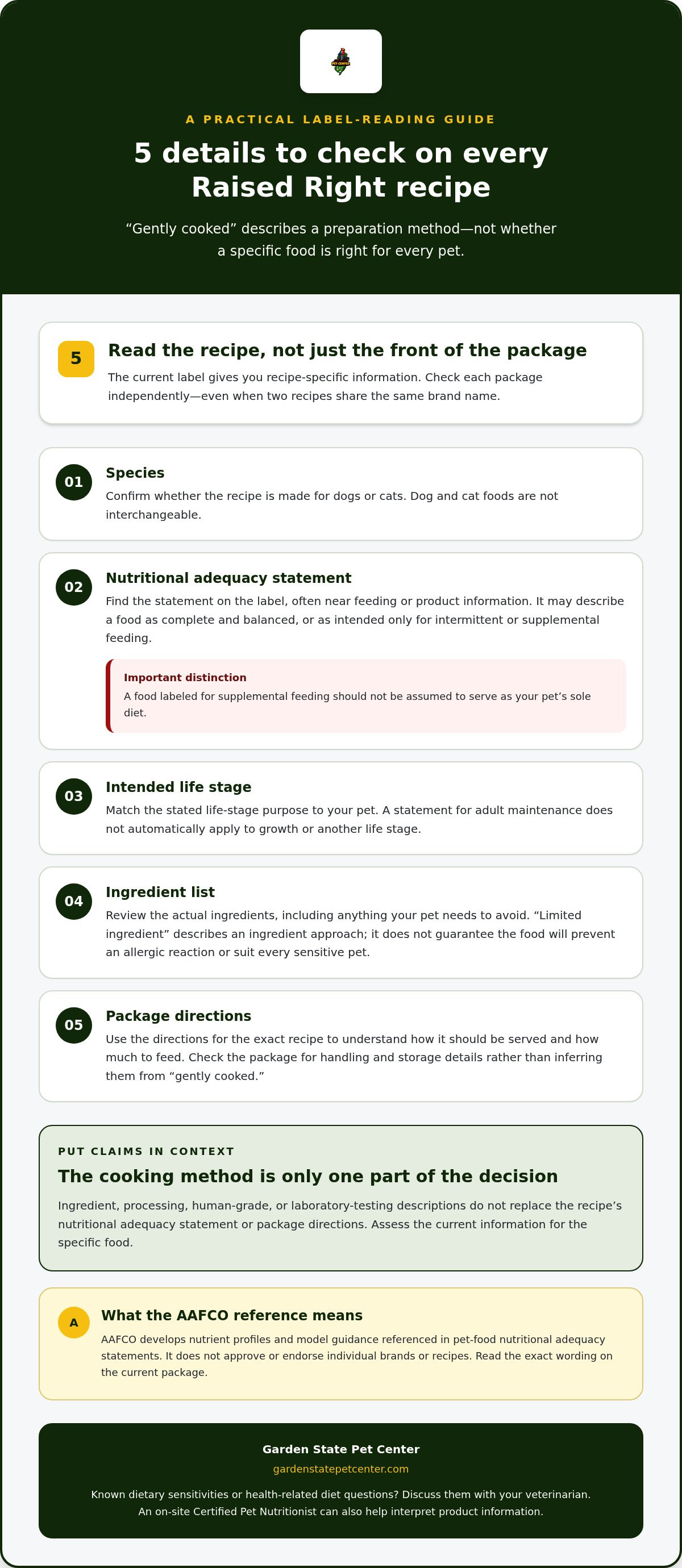
- Use a simple selection checklist: species, life stage, nutritional statement, ingredients, and package directions. Discuss known dietary sensitivities with your veterinarian.
- Garden State Pet Center carries Raised Right Pet Food, and its on-site Certified Pet Nutritionist can help you navigate food choices.
What Is Raised Right Gently Cooked Pet Food?
Raised Right gently cooked pet food is commercially prepared food for dogs or cats that uses cooking as part of its production. “Gently cooked” describes a preparation approach, not a promise that every recipe is nutritionally complete for every animal or appropriate for every need. Garden State Pet Center carries Raised Right Pet Food, alongside gently cooked food for dogs and cats.
Start with the specific package, not just the phrase on the front. Dog and cat foods are made for different species, so their recipes aren’t interchangeable. Check the recipe’s ingredient list, nutritional adequacy statement, intended life stage, and feeding directions. A brand name or cooking style alone can’t tell you whether a food fits your pet.
How gently cooked food differs from home-cooked meals
Commercial pet food is prepared and labeled as a product for pets, with recipe details and feeding directions provided on its packaging. A meal cooked at home is different: its ingredients and proportions depend on the person preparing it, and a familiar combination of meat and vegetables doesn’t automatically provide a complete diet.
Use the current package as your guide. Review the ingredients and directions for the exact recipe you’re considering, including how it should be served and how much to feed. For broader background on dog-food types and considerations, see this Dog Food Overview. Assess the recipe itself rather than assuming that a particular cooking method establishes nutritional completeness.
What the Raised Right name tells shoppers, and what it doesn’t
The Raised Right name identifies the brand, but it doesn’t, by itself, establish the ingredients, nutritional adequacy, or intended life stage of a specific recipe. Those details belong to the product information for that recipe. If a description highlights an ingredient or preparation claim, look for the corresponding details on the current label.
Keep suitability specific to your pet. A recipe may be designed for dogs or cats and for a stated life stage, but those details don’t guarantee that it will match every animal’s needs or dietary sensitivities. Compare the package information with your pet’s circumstances, and discuss known sensitivities or health-related dietary questions with your veterinarian.
Format is another practical consideration. Handling and feeding directions can shape how a food fits your routine, so read the package rather than infer storage or serving details from the term “gently cooked.” Garden State Pet Center’s dry dog food selection offers a point of comparison when considering different dog-food formats. For help navigating food choices, Garden State Pet Center also has an on-site Certified Pet Nutritionist.
How to Evaluate Raised Right’s Recipe and Nutrition Claims
To assess raised right gently cooked pet food, read the label for the individual recipe rather than relying on a brand description or a phrase on the front of the package. The nutritional adequacy statement, species, life stage, and feeding directions help explain what that particular food is intended to provide. These details matter because recipes within one brand can differ, and a general claim shouldn’t be treated as proof about every product.
AAFCO, the Association of American Feed Control Officials, develops nutrient profiles and model guidance referenced in pet-food nutritional adequacy statements. It does not approve or endorse individual brands or recipes. Treat the statement as useful context, then check its exact wording and intended use on the current package.
Read the nutritional adequacy statement recipe by recipe
Look for the nutritional adequacy statement on the recipe’s label, often near the feeding or product information. It may say the food is complete and balanced for a stated species and life stage, or that it is intended only for intermittent or supplemental feeding. These descriptions aren’t interchangeable: food labeled for supplemental feeding shouldn’t be assumed to serve as a pet’s sole diet.
Compare the wording with your pet’s needs. A dog recipe isn’t a cat recipe, and a statement for adult maintenance doesn’t automatically apply to growth or another life stage. If you’re comparing two options, read each package independently. Don’t transfer one recipe’s adequacy statement to another just because both carry the Raised Right name.
Assess ingredient and processing claims in context
Ingredient lists can help you identify what a recipe contains, including ingredients your pet needs to avoid. “Limited ingredient” describes a recipe’s ingredient approach; it doesn’t guarantee that the food will prevent an allergic reaction or suit every sensitive pet. Review the actual list and discuss known dietary sensitivities with your veterinarian.
Descriptions of ingredients, cooking methods, human-grade status, or laboratory testing are claims to assess alongside the current product information. Check the details for the specific recipe rather than assuming that brand-level wording explains everything relevant to your choice. A description of a production process doesn’t replace the nutritional adequacy statement or package directions.
Why review the label recipe by recipe? The exact package identifies the food’s species, life-stage purpose, nutritional adequacy wording, ingredients, and directions. That lets you assess the product in front of you instead of assuming a claim about the brand applies to every recipe.
If label language feels difficult to interpret, Garden State Pet Center’s on-site Certified Pet Nutritionist can help you navigate food choices. Explore pet nutrition support as you compare options.
Raised Right Gently Cooked Food Compared with Other Formats
Food format affects preparation, serving, and storage, but it doesn’t determine whether a recipe is nutritionally suitable. Compare the product’s nutritional statement and intended use, then consider what its package directions mean for your household. The overview below highlights typical format differences. Details can vary by product, so use each food’s current label as the final guide.
| Format | Preparation | Package directions | Storage and household considerations |
|---|---|---|---|
| Gently cooked | Prepared with cooking as part of production. | Follow the recipe’s serving, portioning, and handling directions. | Storage depends on the product. Check the package for where to keep it and how to handle it after opening. |
| Raw | Uncooked food; it is distinct from cooked and freeze-dried formats. | Follow the product’s serving and food-handling instructions. | Use the stated storage directions, which may differ by product and package. |
| Freeze-dried | Moisture is removed during processing; it is not the same as gently cooked. | Check whether the package directs you to serve it as is or prepare it another way. | Follow the label’s storage directions and instructions for any prepared portions. |
| Dry | A dry, packaged format. | Use the food’s stated feeding amounts and serving guidance. | Follow the package’s storage guidance after opening and consider how it fits your household routine. |
Gently cooked versus raw and freeze-dried food
Gently cooked, raw, and freeze-dried describe different preparation formats, not interchangeable labels. Don’t assume that a raw or freeze-dried product should be handled like a cooked one, or that every product in a format has the same storage requirements. Read the specific package for serving and handling directions, and follow them consistently.
For example, one package may provide directions for serving its food directly, while another may specify additional preparation or storage steps. The format gives you a starting point for comparison, but the package tells you what to do with that product.
Gently cooked versus dry food
Gently cooked and dry foods differ in physical format and may have different package directions. Compare how each food is portioned, served, and stored after opening rather than assuming one is easier or nutritionally superior. Garden State Pet Center’s dog food selection provides context for comparing options across formats.
Choose based on the individual recipe, your pet’s needs, and the routine you can follow reliably. For raised right gently cooked pet food, as with any format, check the recipe’s nutritional statement and use its own directions. A format comparison can help narrow your options, but it can’t replace recipe-level evaluation or guidance tailored to your pet.
How to Choose and Introduce a Raised Right Recipe
Use a label-first process to narrow your options, then follow the package and veterinary guidance as you introduce a new food. For raised right gently cooked pet food, the right choice depends on the specific recipe and your pet, not just the brand or format.
- Match the species. Choose a dog recipe for a dog or a cat recipe for a cat. Their nutritional needs differ, so don’t substitute one species’ food for another.
- Check life-stage suitability. Read the current package to see which life stage the recipe is intended for. Don’t assume an adult recipe is appropriate for growth or another stage.
- Read the nutritional statement. Look for the recipe’s statement of nutritional adequacy and intended use. Distinguish food labeled complete and balanced for a life stage from food intended for intermittent or supplemental feeding.
- Review ingredients and directions. Check the ingredient list for items relevant to your pet, then follow the recipe’s instructions for portions, thawing, serving, storage, and leftovers. Don’t apply directions from a different recipe or food format.
Match the recipe to your pet’s needs
After confirming species and life stage, review the ingredient list and feeding directions. Recipe names or prominent ingredient descriptions can help you identify an option to examine, but they don’t replace the label details. If your pet has a known dietary sensitivity, discuss the ingredient list with your veterinarian before making a change. For a medical condition or therapeutic diet requirement, ask your veterinarian whether a particular food is appropriate.
Consider your pet’s current diet and any specific feeding advice you’ve received. A recipe that meets the label criteria may still need individual consideration, especially if your pet has a health concern. Garden State Pet Center’s on-site Certified Pet Nutritionist can help you navigate food choices and interpret nutrition information alongside your veterinarian’s recommendations.
Transition and handle food according to its directions
A gradual transition is general guidance, not a fixed schedule for every pet. Follow the current package instructions and any transition plan recommended by your veterinarian. If your pet has a medical condition, a history of food sensitivity, or specific dietary instructions, seek veterinary guidance before changing the diet. Monitor your pet during the transition and consult your veterinarian if you have concerns.
Handle the food according to its own package. Check the directions for thawing, portioning, serving, storage after opening, and leftovers. Don’t guess about freezer or refrigerator timelines, serving temperature, or how long food can remain out; those details can vary by product. Keep the package available so you can refer to its instructions as needed.
For help weighing recipe details against your pet’s needs, connect with the on-site Certified Pet Nutritionist at Garden State Pet Center.
Find Raised Right Pet Food with Knowledgeable Nutrition Support
Choosing a food is easier when you can compare recipe details with your pet’s needs and your household routine. Garden State Pet Center carries Raised Right Pet Food and gently cooked food for dogs and cats. Its on-site Certified Pet Nutritionist can help you navigate food choices and product information. Bring questions about a recipe’s intended life stage, feeding directions, or ingredient list.
For broader context on comparing diets, use a premium pet food guide to consider the factors behind a food choice. Then refer to the current package to verify details for a specific Raised Right recipe. The goal is to make an informed comparison, not to assume one format or brand suits every pet.
Get help comparing premium food formats
Garden State Pet Center carries raw, freeze-dried, and gently cooked foods, giving pet owners several formats to consider. Nutrition guidance can help you read labels side by side, clarify differences in package directions, and identify questions to discuss with your veterinarian if your pet has a known sensitivity or medical dietary need. This support can inform your selection, but it doesn’t replace veterinary care or diagnosis.
To make the conversation practical, have the recipe’s current label available and note your pet’s species, life stage, current food, and any ingredients you’re avoiding. You can then focus on the details that affect your decision: nutritional adequacy wording, ingredients, feeding instructions, and storage directions. If you’re comparing formats, look at how their package directions differ rather than assuming handling is the same.
Take the next step with Garden State Pet Center
Explore food options with your pet’s individual needs in mind. If you’re considering raised right gently cooked pet food, use the current recipe label as your starting point and bring any details you’d like help interpreting. The on-site Certified Pet Nutritionist can help you navigate food choices and compare information across premium formats, while your veterinarian remains the right resource for medical or therapeutic diet advice.
Ready to compare options? Explore premium pet food and discuss your recipe-label questions with the Garden State Pet Center team. A clear conversation about the label, feeding directions, and your pet’s needs can help you move forward with confidence, without relying on broad claims or assumptions about a food’s format.
Make Your Next Food Choice with Confidence
A thoughtful food decision doesn’t have to be permanent. Treat your next step as an informed choice you can revisit as your pet’s needs, routine, or veterinary guidance changes. Keep the package details handy, note any questions that come up during feeding, and use those observations to guide future conversations about your pet’s diet.
If you’re considering raised right gently cooked pet food, connect the recipe information with what matters for your individual pet. A clear, practical approach can make premium-food decisions feel less overwhelming and help you choose with greater confidence.
Explore premium pet food and get knowledgeable guidance from Garden State Pet Center. Take your questions along and make the next step one that feels right for you and your pet.
Frequently Asked Questions
Is Raised Right gently cooked food complete and balanced?
It depends on the specific recipe and its current label. Raised Right has stated that many recipes are formulated to meet AAFCO nutrient requirements, but that doesn’t establish the intended use of every recipe. Check the package’s nutritional adequacy statement, species, and life stage. AAFCO provides nutritional standards; it doesn’t endorse individual brands. If the wording is unclear, a pet nutrition professional can help you interpret it.
Can cats eat Raised Right gently cooked dog food?
No. Choose food labeled for the species it is intended to feed. A dog recipe should not replace a cat recipe, since cats and dogs have different nutritional requirements. Don’t use a dog food as a cat’s regular meal just because both packages describe gently cooked food. Check the recipe label and feeding directions, and consult your veterinarian or a qualified pet nutrition professional if you’re unsure.
How much Raised Right gently cooked food should I feed my dog?
Use the feeding directions on the current package for the specific recipe, then discuss adjustments with your veterinarian if your dog needs individual guidance. A serving chart from a different recipe may not apply. If your dog’s activity or body condition changes, don’t rely on a generic amount found online. Ask your veterinarian for advice if there’s a medical concern or a noticeable change in appetite or weight.
Does gently cooked pet food need to be refrigerated or frozen?
Follow the storage directions on the exact product package, since requirements can differ. Read the instructions for unopened food, opened packages, thawing, and leftovers rather than assuming every gently cooked food is handled alike. If a package has been stored outside its stated directions, don’t guess about whether it remains suitable to serve. Contact your veterinarian if your pet seems unwell after eating.
Is Raised Right gently cooked food suitable for puppies?
It may be suitable only if the specific recipe’s current nutritional adequacy statement covers your puppy’s growth life stage. An adult-maintenance statement alone doesn’t show that a recipe is intended for a growing puppy. Before switching, review the label and discuss the change with your veterinarian, especially if your puppy has a health concern or follows a prescribed feeding plan. Keep the package information available for that conversation.
Can I switch my pet to gently cooked food all at once?
A gradual change is commonly used, but the best approach depends on your pet and the foods involved. Follow the package guidance and ask your veterinarian for an individualized plan if your pet has a sensitive digestive history or medical condition. During the change, keep track of meals and any changes in appetite or stool. That record can help your veterinarian assess how your pet is responding and advise you on next steps.

Article by
Victor Santucci
Victor Santucci Jr. is the owner of Garden State Pet Center and a Certified Clinical Pet Nutritionist specializing in premium pet nutrition, raw and fresh feeding, holistic pet wellness, birds and exotic animals. Through years of hands-on retail and animal-care experience, Victor helps pet parents make informed decisions about nutrition, enrichment and species-appropriate care.
Share this post
- 0 comment
- Tags: cat food, dog food, gently cooked pet food, healthy pet food, pet food labels, pet nutrition, raised right, raised right gently cooked pet food